The ingredient / GHK-Cu
The science
starts small.
Three amino acids — glycine, histidine and lysine — form the peptide GHK. When it binds copper, the resulting complex is known as GHK-Cu.
A small structure with a long research history. Let’s take a closer look.
The research, in context
Decades of questions.
1973 / A beginning
A peptide in human plasma
Pickart and Thaler reported a human plasma factor studied in cultured liver cells. This early work is part of GHK’s research history; it was not a trial of a topical skincare serum.
1980–1981 / Copper binding
Understanding the complex
Researchers examined copper’s association with GHK and the properties of that complex. GHK and GHK-Cu are related terms, but one describes the peptide and the other its copper complex.
1988–1992 / Laboratory models
Questions about skin biology
Studies in cultured fibroblasts explored collagen synthesis and glycosaminoglycan synthesis. Cells in a laboratory help researchers ask focused questions; they do not show how a finished serum performs on a person’s skin.
A thoughtful distinction
Research is context.
Formulation matters.
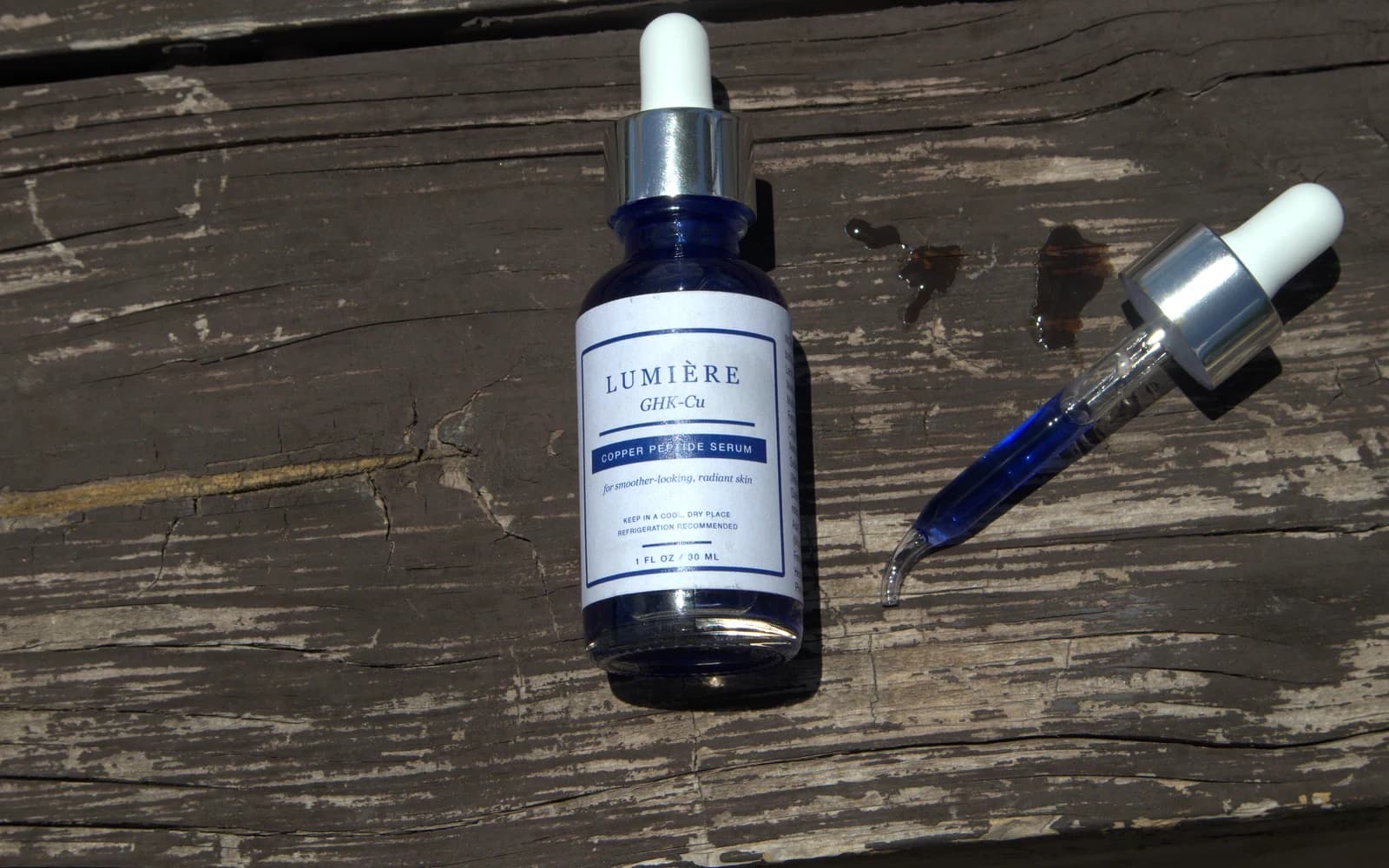
An ingredient study and a finished-product study answer different questions. Formula, concentration, delivery, study design and the people involved can all change what a result means.
We have not published a clinical trial of the Lumiere Routine finished serum. We do not use laboratory findings to promise collagen production, tissue repair, a particular timeline, or a guaranteed result from our bottle.
Read the research guide ↗Learn to read skincare research ↗